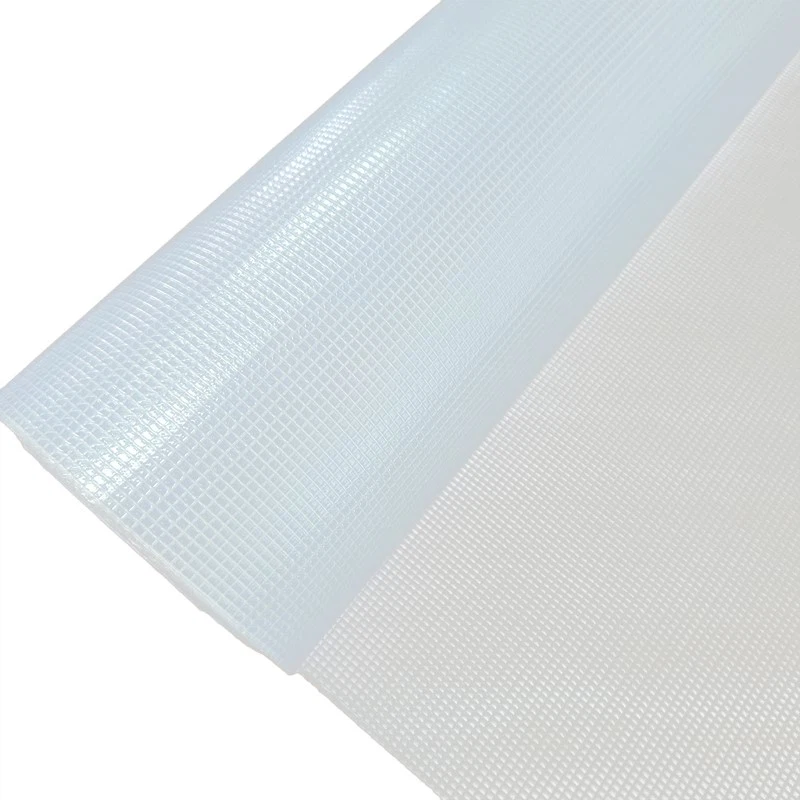
The design concept of PVC mesh-reinforced fabric stems from the engineering pursuit of high strength and all-weather protective functions. Its core is to achieve excellent durability, protection, and environmental adaptability on a lightweight basis through innovative composite material structures and process technologies.
Structural Design: Composite of Bionic Skeleton and Sealing Barrier
The basic design of PVC mesh-reinforced fabric adopts a "skeleton + sealing layer" composite structure, similar to the combination of reinforced concrete or the skeleton and skin of a living organism.
Skeleton Layer: Woven from high-strength polyester (PET) fibers into a mesh substrate, it serves as the main load-bearing component of the material, providing excellent tensile strength and tear resistance, ensuring that the material does not easily deform or break under stress.
Sealing Layer: A PVC coating is applied to both sides of the mesh substrate through high-temperature lamination or coating processes, forming a continuous and dense protective barrier. This layer mainly gives the material complete waterproof, moisture-proof, dust-proof, and corrosion-resistant properties.
This design achieves separation of functions and synergy: The inner mesh bears mechanical stress, and the outer PVC layer blocks environmental erosion, allowing the material to withstand physical loads such as wind and pulling while effectively preventing the intrusion of moisture, UV rays, and other environmental factors over time.
Performance Design: Engineered Indicators for Extreme Environments
The design objectives are clearly aimed at harsh conditions in outdoor and industrial applications, with performance indicators far exceeding those of ordinary fabrics.
All-Round Protection: 100% waterproof (water forms beads and rolls off the surface)
Excellent UV Resistance
Good Flame Retardancy
Oil and Chemical Resistance
Outstanding Durability: High tear and puncture resistance allow it to withstand mechanical damage from water impact and sand and stone abrasion. The material remains flexible within a temperature range of -10°C to 50°C, and is not prone to hardening at low temperatures or the formation of micro-gaps that cause water leakage from repeated folding.
Stability and Lightweight: Strong dimensional stability, not easily shrinking or deforming after exposure to sunlight or rain. At the same time, by optimizing material density and thickness, weight is controlled while ensuring protective strength, improving portability.